
The Phage Receptor-Binding
Protein Database
A central hub for tail fibers and tailspikes
Every phage protein from GenBank and UniProtKB, screened for receptor-binding proteins by six evidence sources and enriched with predicted structures, domains and phage–host metadata. Search it by sequence, structure, domain or taxonomy — in the browser or through the OpenAPI.
Query your protein Search the database How it's builtDatabase features
Four ways into the PhaRBP web portal
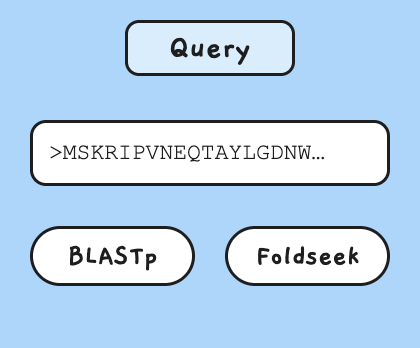
Bring your own protein: find similar RBPs by sequence (BLASTp) or predicted structure (Foldseek).
Open Query →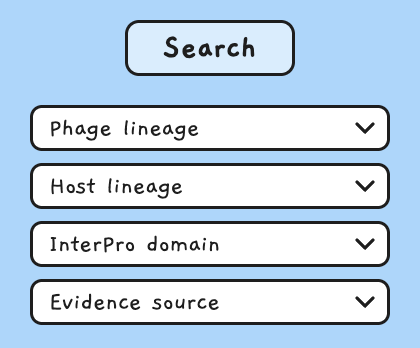
Combine phage and host lineage, InterPro domains and annotation-evidence filters.
Open Search →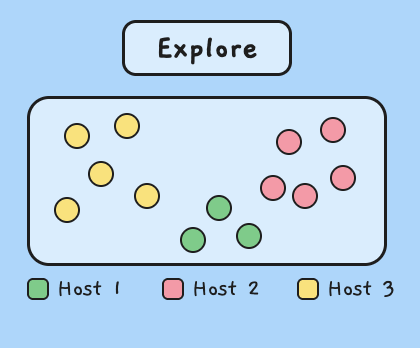
Browse the structural similarity map and the domain architecture viewer across phages and hosts.
Open Explore →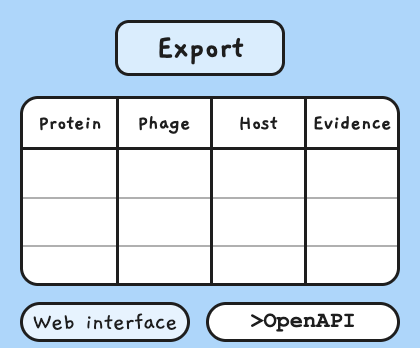
Build custom tables of protein, phage, host and evidence columns — in the web interface or via the OpenAPI.
Open Export →PhaRBP pipeline
From raw phage proteomes to an annotated, searchable RBP resource
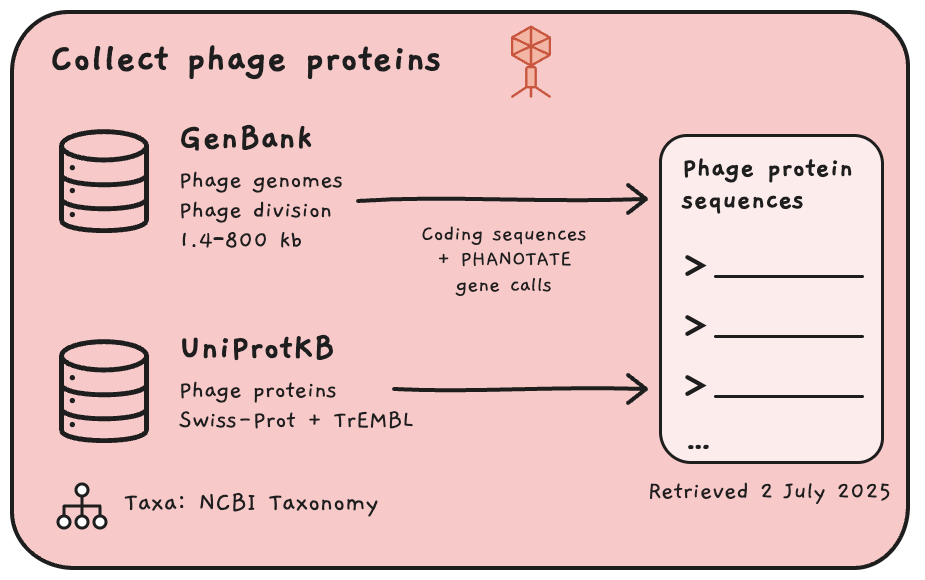
Collect phage proteins
Phage proteins are collected from GenBank (phage division, 1.4–800 kb genomes) and UniProtKB (Swiss-Prot + TrEMBL), supplemented with PHANOTATE gene predictions. Taxa are resolved against NCBI Taxonomy.
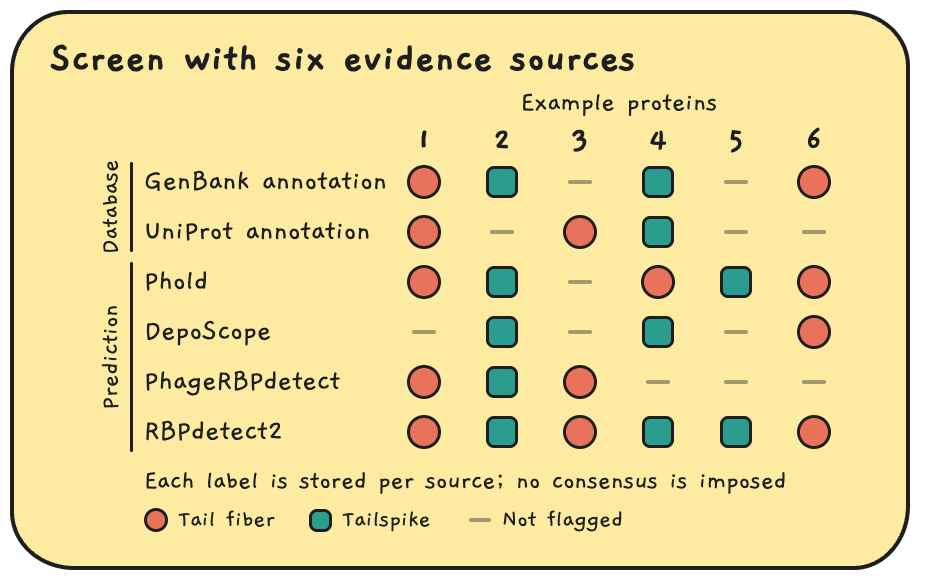
Screen with six evidence sources
RBPs are identified using six annotation and prediction sources. Each source's label and score is kept and stays available for inspection — no consensus is imposed.
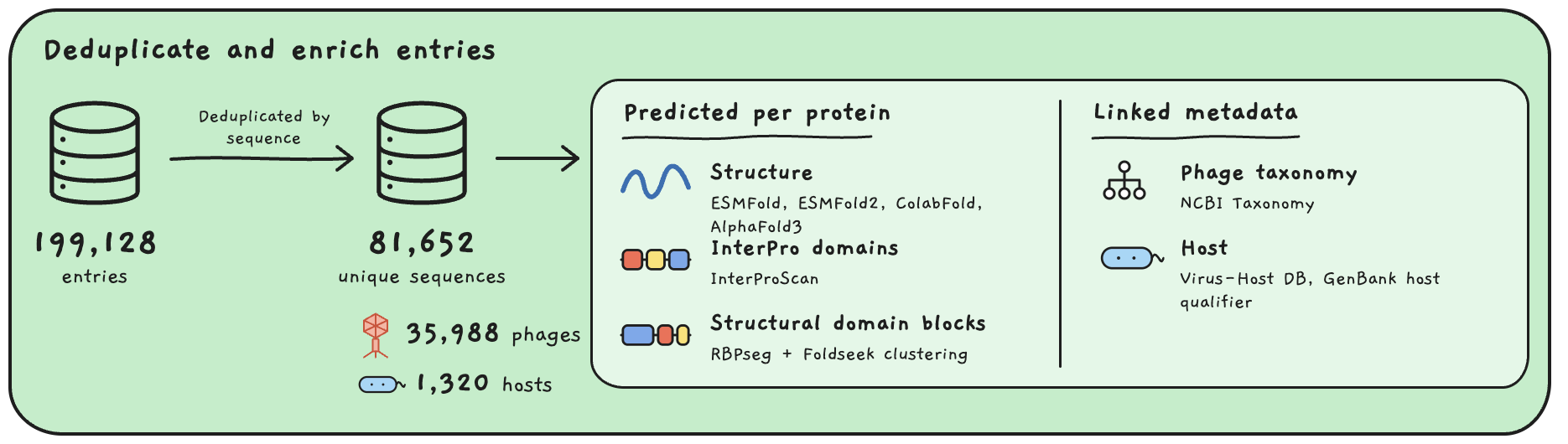
Deduplicate and enrich entries
Records are deduplicated by sequence and enriched with predicted structures (ESMFold, ColabFold, AlphaFold3), InterPro domains, RBPseg structural domain blocks, and phage and host metadata — yielding 199,128 entries representing 81,652 unique sequences.
Database schema
26 tables, 220 columns, 28 foreign keys
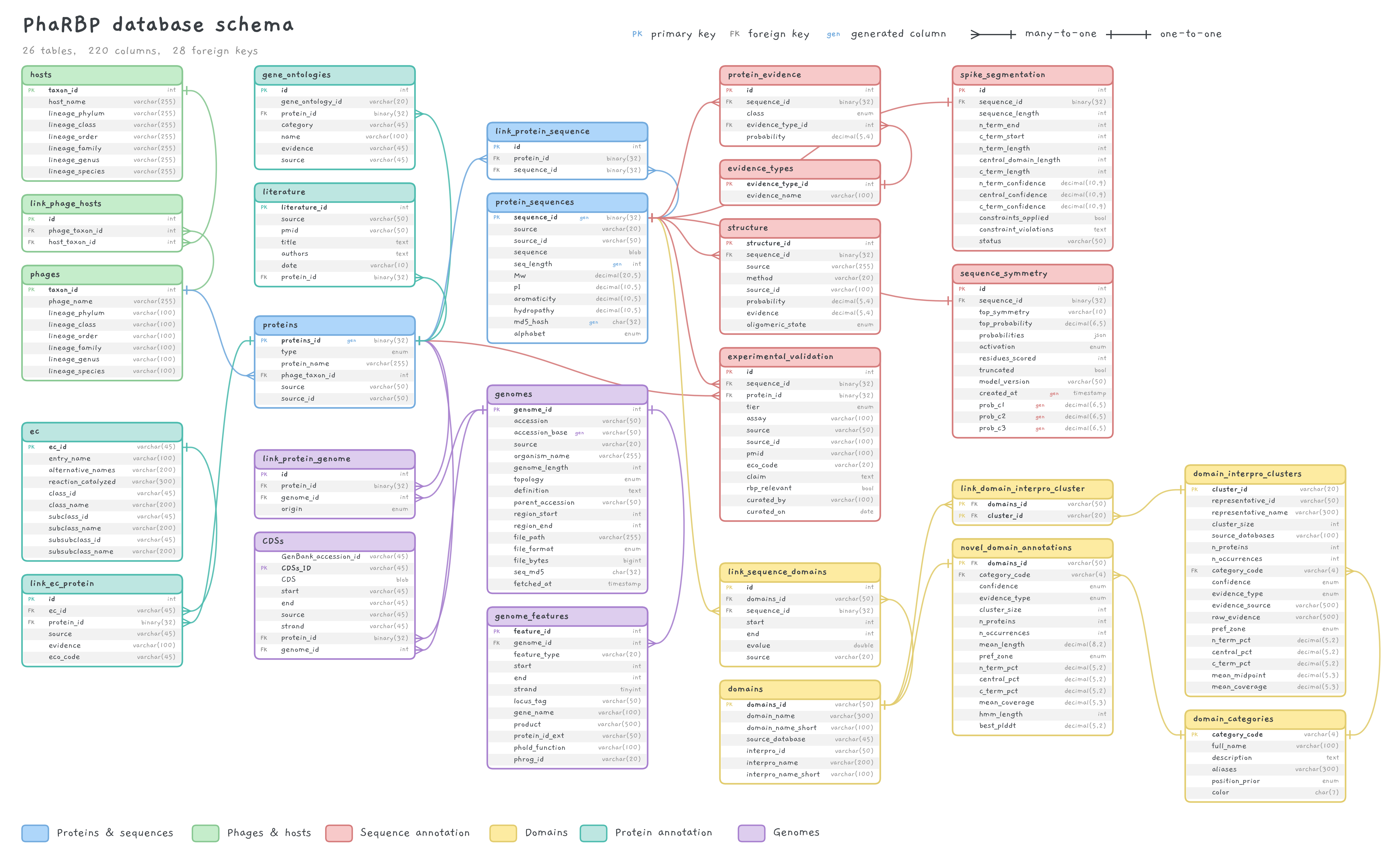
Proteins ↔ sequences
Proteins link many-to-many to unique sequences, so every sequence and structure is stored once.
Annotation on the sequence
Evidence, structures, domains, symmetry and spike segmentation attach to the unique sequence.
Context on the protein
Phage, host, genome, literature, GO terms and EC numbers attach to each protein record.